Arizona's argument over Empowerment Scholarship Accounts keeps collapsing into one word: defunding. It is a good word for a flyer. It is a bad word for a budget.

An ESA does not take a district's property taxes. It does not take federal Title money. It does not take Classroom Site Fund dollars. Under ADE rules and A.R.S. § 15-2402, the account is about 90 percent of the state formula aid that would have followed that student to a district or charter — and only after the student leaves. Local and federal dollars never enter the account. ESA students also get $0 from the Classroom Site Fund, roughly $1,000 per public-school pupil that stays put.
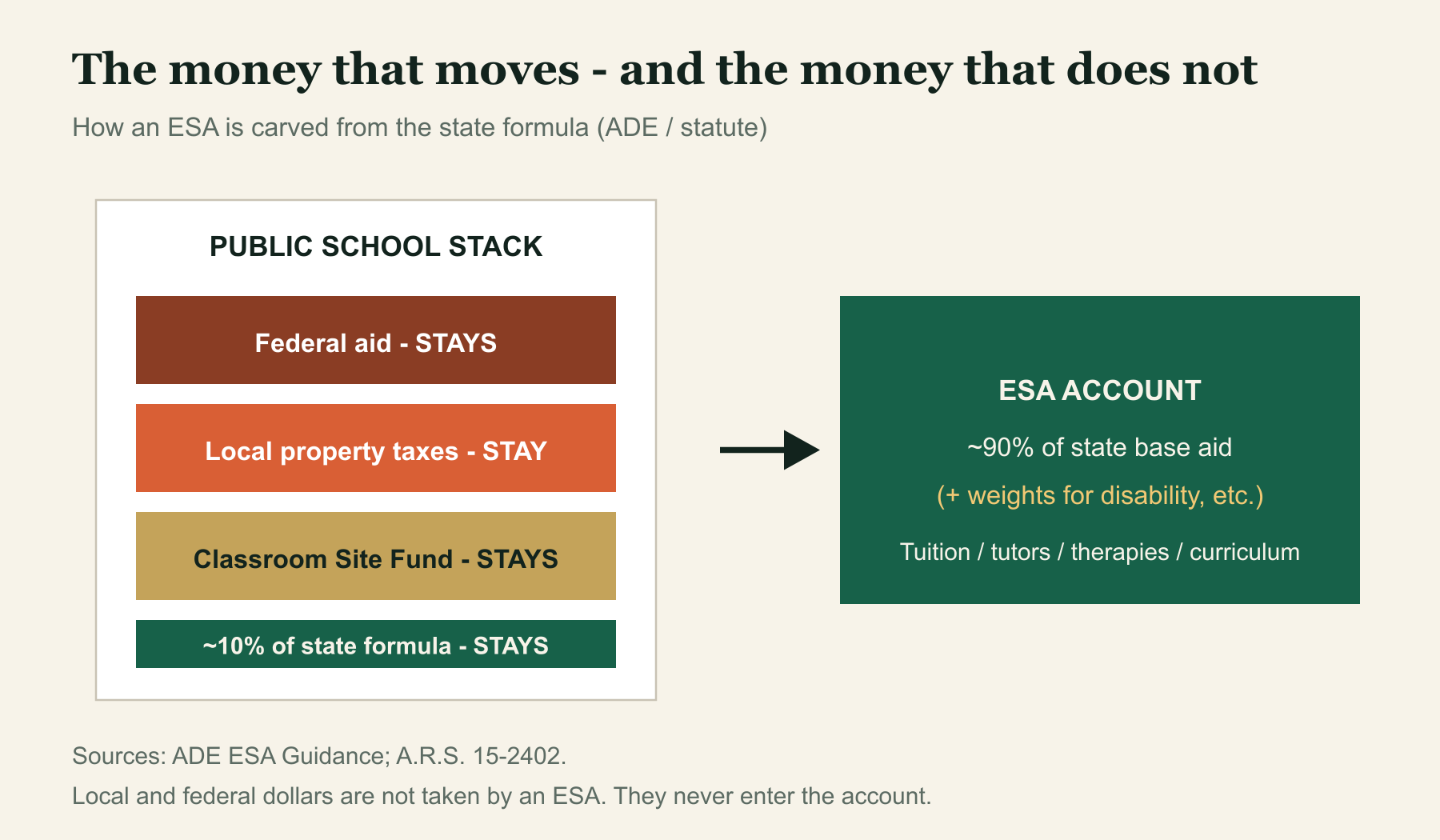
An ESA moves roughly 90% of state formula aid. Local taxes, federal aid, and Classroom Site Fund dollars stay with the public system.
An ESA moves roughly 90% of state formula aid. Local taxes, federal aid, and Classroom Site Fund dollars stay with the public system.Saguaro Signal graphic from ADE guidance and A.R.S. § 15-2402.

If "defunding" means the public pile got smaller after universal expansion, the JLBC tables do not cooperate. In FY 2022, the year HB 2853 opened ESAs to every K-12 student, state and local K-12 funding was about $11.8 billion, or $10,657 per student. By FY 2024 it was $14.0 billion and $12,726. JLBC's FY 2026 estimate is $14.4 billion and $13,325. That is roughly $2.6 billion more in state and local money while ESA enrollment climbed past the old niche program and into six figures.
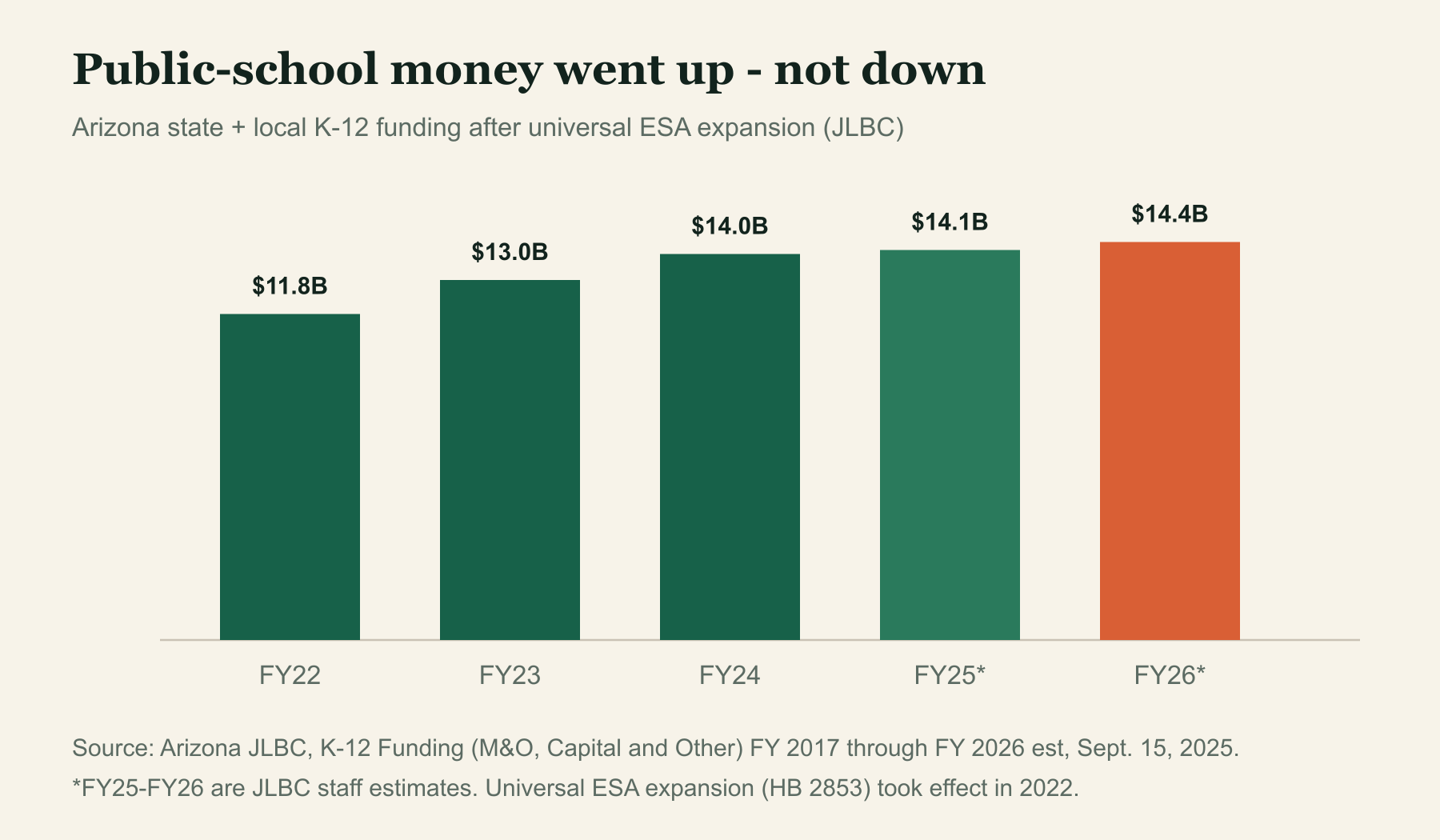
State and local K-12 funding rose from about $11.8 billion in FY 2022 to an estimated $14.4 billion in FY 2026.
State and local K-12 funding rose from about $11.8 billion in FY 2022 to an estimated $14.4 billion in FY 2026.Saguaro Signal chart from JLBC all-funding series (Sept. 15, 2025).

After inflation, the same JLBC series still points up: state-and-local funding per student moves from $9,843 in FY 2022 to $10,358 in the FY 2026 estimate — more than $500 higher. You can dislike ESAs and still have to explain why a rising appropriation counts as a raid.

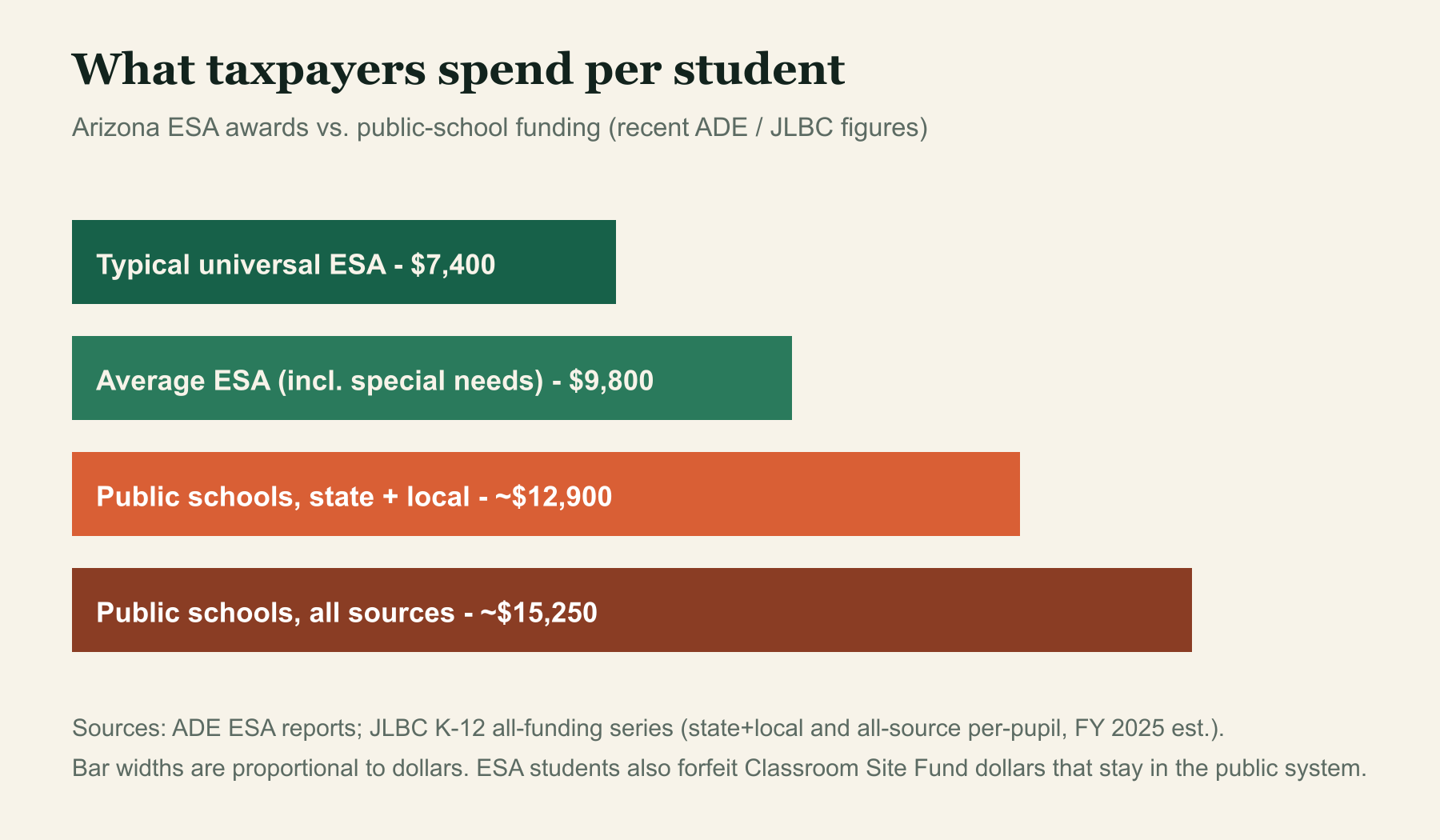
The cost-per-kid math is worse for the bankruptcy claim. ADE reporting puts a typical universal ESA near $7,400. The average award, lifted by a higher share of students with disabilities, is about $9,800. JLBC's FY 2025 all-source public-school figure is about $15,250 per student; state-and-local alone is near $12,900. A scholarship that costs less than the fully loaded public seat is an odd definition of looting the schools.
ESA awards cost thousands less per student than Arizona’s public-school funding levels.
ESA awards cost thousands less per student than Arizona’s public-school funding levels.Saguaro Signal chart using ADE ESA award figures and JLBC per-pupil funding.

There is a sharper critique, and JLBC staff have said it out loud: some ESA users were already private or homeschooled, so the General Fund picks up a new cost without an immediate ADM drop. The Learning Policy Institute built a whole paper around that "nonswitcher" bill. Fair enough. That is an eligibility cost, the same species of cost as every other time the Legislature widened who gets a state benefit. It is not evidence that district budgets were stripped while total state and local K-12 spending rose by billions.

In several budget cycles, ADE and JLBC also showed combined district, charter, and ESA formula costs coming in under enacted assumptions because public ADM fell as ESA counts rose. The first universal year posted a surplus; a later cycle showed a small net savings in the education formula versus the enacted budget once both sides of the ledger were counted. Statewide shortfalls since then have plenty of parents — tax cuts, Medicaid, one-time federal money running out — without needing a single scholarship line to carry the blame alone.

Empty classrooms get blamed on ESAs the same way. Birth rates fell. Some families left town. A lot of "lost" kids never left public school; they left one public operator for another. In Roosevelt Elementary, only 102 prior district students went to an ESA, while more than 8,000 kids living in those boundaries attend other public schools Roosevelt does not run. ESAs are part of the enrollment story. They are not the whole story, and treating them as the whole story is how a complicated district problem becomes a simple villain.

Arizona did not invent ESAs in a vacuum. After Cain v. Horne killed a disability voucher in 2009, lawmakers built the account model in 2011 — tuition, tutors, therapies, curriculum, not just a check to a school. Niehaus v. Huppenthal upheld it. The Supreme Court left that alone. Pierce v. Society of Sisters and A.R.S. § 1-601 are the older scaffolding: parents direct the child's education; the child is not a ward of the assigned campus. Universal eligibility in 2022 made that operational for families who could not write a second tuition check.

The user base is not a country club. ADE enrollment reports show a higher disability share than the public system, kids leaving D and F schools, military families, and about half of recent joiners coming straight from public school. Income surveys of private-school families show large shares under $100,000, including many under $50,000. Taxpayers already fund rich kids in district seats with no means test. The means test only appears when the family leaves the building.

On tuition, post-expansion comparisons put the typical ESA near median K-8 private tuition, with no inflation-beating spike after universal. That does not make every high school cheap. It does undercut the idea that the award is a decorative coupon for people who were paying sticker price anyway.

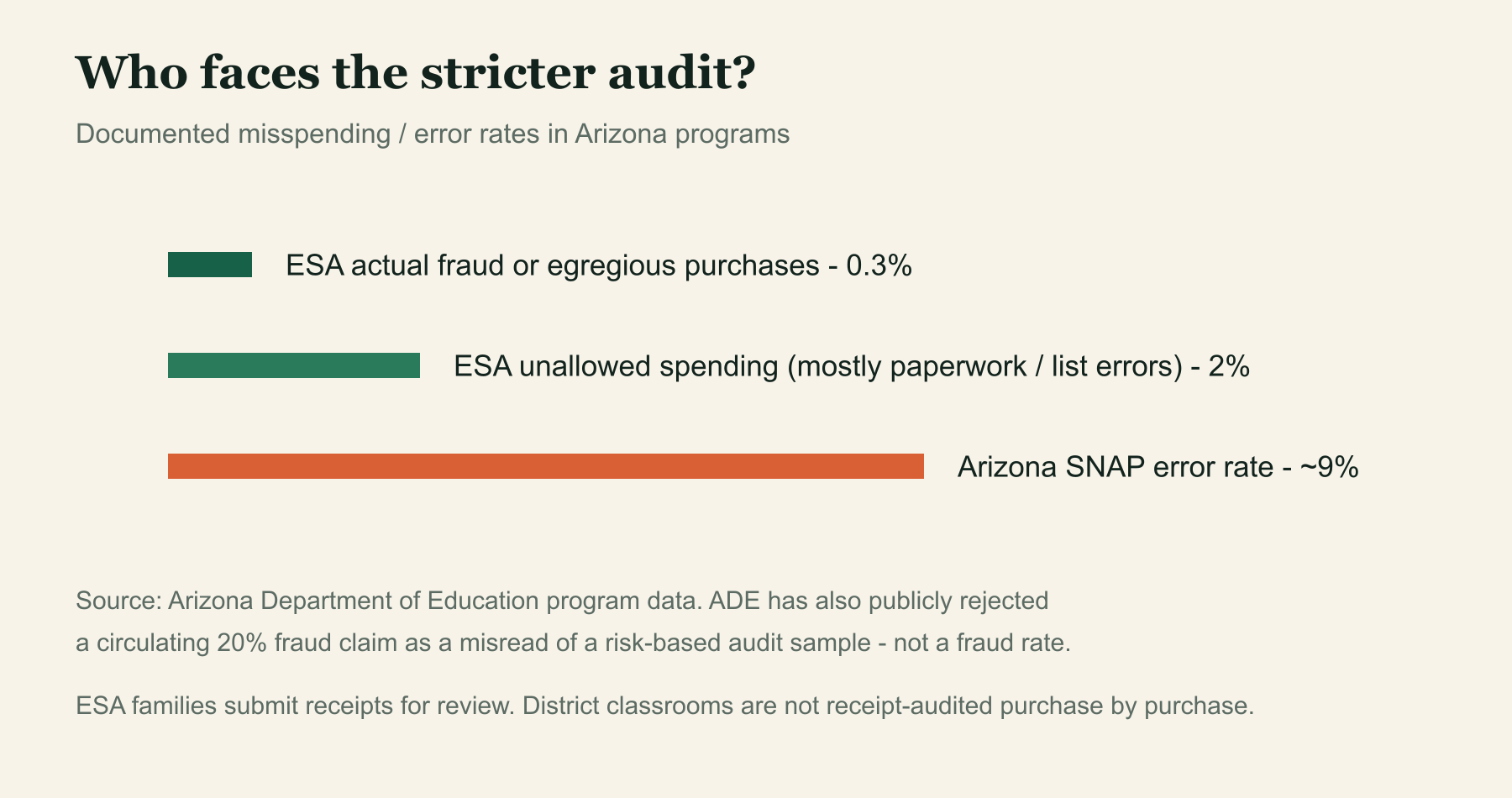
Fraud talk travels faster than ADE's footnotes. ADE has put unallowed spending near 2 percent and "actual fraud or egregious" purchases near 0.3 percent. The department also rejected a viral 20 percent fraud figure as a misread of a risk-based audit sample. Unallowed often means a missing form or an item not on the list. Arizona's SNAP error rate runs near 9 percent. The Auditor General has said about 52 cents of each district dollar reaches classroom instruction. District conference travel keeps making the papers. ESA parents upload receipts. The double standard is the point of the talking point.

ADE-reported ESA misspending rates are far below Arizona’s SNAP error rate — and nowhere near the viral “20% fraud” claim ADE rejected.
ADE-reported ESA misspending rates are far below Arizona’s SNAP error rate — and nowhere near the viral “20% fraud” claim ADE rejected.Saguaro Signal chart from ADE program data.

Contracts still require reading, grammar, math, social studies, and science. Statute keeps the state from running nonpublic schools through the program. Public schools answer to voters, audits, and letter grades. Those are different accountability systems. Calling one unregulated because it is not the other is a category error.

Test-score research will not settle this cleanly. Choice studies elsewhere go both ways. Arizona's own public proficiency figures — roughly 40 percent in reading, 34 percent in math, while most schools still wear A or B labels — do not leave opponents with an easy claim that the status quo was a finished product ESAs vandalized.

The 2026 ballot fight will dress itself in softer words. One camp wants a constitutional guarantee, often sold around military families. Save Our Schools wants income caps and unused balances sent back under a "protect education" banner. If the debate is about clawing back unused balances as cash management, say that. If it is about ending universal eligibility, say that. Do not call either move proof that JLBC's rising K-12 totals were a mirage.

Districts with falling ADM and fixed buildings have real problems. Rural schools feel them differently than Phoenix. Special education weights matter. Those are reasons to run a better formula and a clearer facilities plan. They are not proof that a $7,400 account for a child who left explains why the state's K-12 commitment went up.

ESAs are not defunding public schools. They stop paying the full public rate for a seat nobody is sitting in, leave local and federal dollars where they were, and operate next to a Legislature that has kept growing the K-12 stack. "Defunding" survives because it polls. The books do not.

Sources Cited

See an error? Email corrections@saguarosignal.com. We append material corrections to the article.