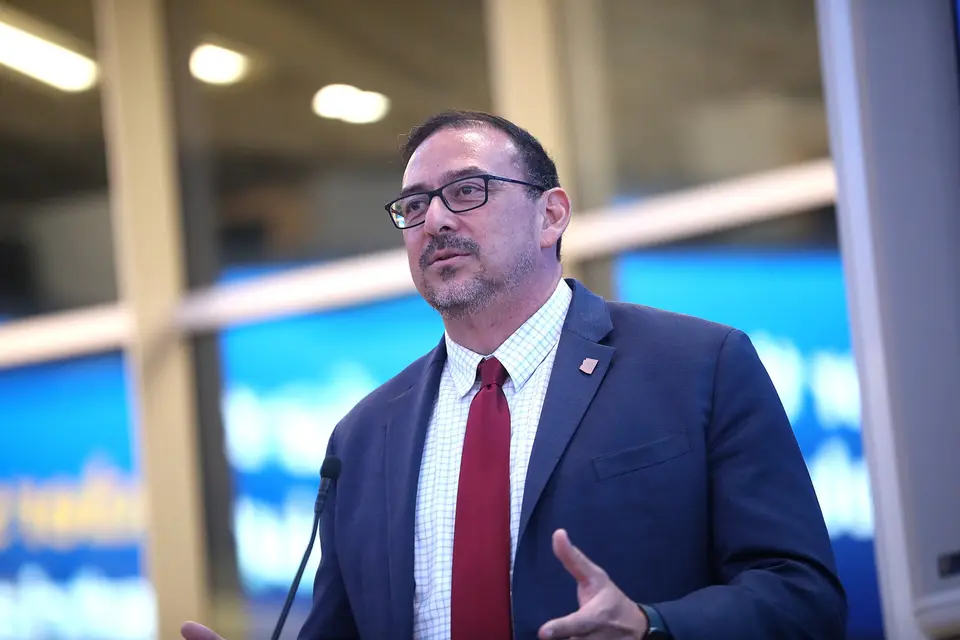

The bipartisan headline Hobbs wanted is colliding with the file drawer. According to the Arizona Globe, which cites Axios, Mesa’s former mayor John Giles left the Republican Party in May, weeks before Democrats began floating him as Gov. Katie Hobbs’ running mate.
That timing matters because Hobbs’ reported pick was sold as a Republican crossing the aisle to help her fend off GOP nominee Andy Biggs. If Axios’ voter file review is right, Giles is no longer crossing an aisle. He already walked out the door and, per the Globe’s account, later took a Democratic primary ballot that independents in Arizona are allowed to request.
The consequence is straightforward. A ticket billed as bipartisan persuasion looks more like branding. Voters who still identify as Republican will judge whether a no-party-preference voter who has endorsed Democrats across four consecutive cycles can credibly speak for them, or whether he mainly signals comfort to independents who were already leaning Hobbs.
The Globe recounts that Giles registered as a Republican in 1986, voted in GOP primaries for decades, and served as Mesa mayor from 2014 to 2025. His public break with the party was gradual and very public: he has said he voted for Joe Biden in 2020, joined Republicans for Mark Kelly in 2022 and endorsed Hobbs over Kari Lake that year, drawing a censure from the Maricopa County Republican Party. In 2024 he endorsed Kamala Harris, appeared as a Republican surrogate, and spoke at the Democratic National Convention.
None of that is disqualifying on its face. It does clarify the product Hobbs is offering. This is not outreach to Republicans inside today’s GOP. It is a reaffirmation of a coalition of Democrats, independents, and former Republicans who already left. Whether that coalition is sufficient depends on turnout and persuasion among current Republicans, neither of which this pick obviously unlocks.
The Globe reports that Hobbs has not formally announced Giles. It also notes a basic accountability gap: neither Hobbs nor Giles has explained why Giles changed his registration in May or whether that decision preceded any running mate discussions. Voters deserve a clean timeline. If the governor intends to market a bipartisan partnership, the sequence and substance should be on the record.
Even the campaign’s language is doing a lot of work. The Globe says Hobbs’ team touted his June 26 reelection endorsement by calling him a “former Republican mayor.” That phrasing is technically accurate and strategically slippery. It leans on a past label to suggest cross-party credibility without acknowledging the present-day registration change and primary ballot choice that point the other way.
Context on the other side of the ticket is simpler. The Globe reports Biggs named state Sen. Sine Kerr, a conservative, as his running mate. Voters now face a contrast between a clearly Republican ticket and a ticket leaning into the aesthetic of bipartisanship. If persuading current Republicans is the mission, the aesthetic will not be enough.